Showing posts with label new york times. Show all posts

March 4, 2009

Roger Cohen Tonight at Memorial Chapel

Roger Cohen, Editor-at-Large for the International Herald Tribune and frequent contributor to the New York Times Op/Ed page, will give a lecture at 8pm tonight entitled "The New Middle East and its Challenges to America".

This will be a great opportunity to ask questions if you've been following the discussion surrounding Cohen's recent piece on Iran and its Jewish population.

Who: New York Times Op-Ed columnist Roger Cohen
What: "The New Middle East and its Challenges to America"
Where: Memorial Chapel
When: 8pm tonight

This event is hosted by the Wesleyan Student Assembly and made possible by the New York Times Readership Program.

February 4, 2009

For the Nostalgic New Yorker


If you miss home, as many of us do this time of year, check out the New York Times' "I LEGO NYC" blog by Christoph Neimann.
Even if you're not a native New Yorker, hopefully you can find something that will bring a little cheer. My favorites are the cream cheese lego, the plastic bag stuck in the tree and the dog poop, all images that define my neighborhood.

-- Courtesy of Sarah Telzak '11

December 3, 2008

NYT Readership Program Reduced


Last year, the price of the NYT Readership Program went up substantially. The WSA approached the administration departments who are currently helping us pay for the program and asked if they'd join us in increasing the budget for the program so that we could keep the delivery at the same level. We also approached new departments.

Unfortunately, the program was not a high enough priority in the context of ongoing budget reductions; not only did the administration refuse to meet our budget increase, but they also decided to completely withdraw their support for next year.

The WSA decided that for the current year we would retain the higher delivery quantity through the election to meet increased demand, and then pay the price later with a severely reduced delivery. That time has come, and as of November 17 we have only been receiving half as many papers as we received during the election.

The WSA is still committed to this program, and in the email I sent out this morning, I asked you to contact me if you are interested in saving it. We are in the early stages of planning a potential solution that we will need your help on next semester, so please do send me an email. My address is scarlin@wes.

In the meantime, you can read the New York Times online at nytimes.com. It's free and paperless.

-Saul Carlin '09, WSA veep

College may become out of reach for most in U.S.

And you thought bigger class sizes might be a problem.

According to a report from the National Center for Public Policy and Higher Education, college may soon be financially out of reach for most Americans. Highlighted in an article by the New York Times, the report found that

published college tuition and fees increased 439 percent from 1982 to 2007, adjusted for inflation, while median family income rose 147 percent. Student borrowing has more than doubled in the last decade, and students from lower-income families, on average, get smaller grants from the colleges they attend than students from more affluent families.
The article goes on to note that Americans aged 25–34 are less educated than older workers, and that, with less access to credit due to the current recession, the trend of increasing college enrollment may soon lose steam. That isn't so hard to believe with stats like these:
Last year, the net cost at a four-year public university amounted to 28 percent of the median family income, while a four-year private university cost 76 percent of the median family income.
I'm no math major, but my quick-'n'-dirty calculations tell me that the cost of a Wesleyan education represents an astonishing 94 percent of the median annual income of an American family.

NYT: College May Become Unaffordable for Most in U.S.

November 21, 2008

Wesleyan Early-Decision Applications Up 40%

A New York Times article reported today that Wesleyan Early-Decision Round I applications increased by forty percent. While this year was initially speculated to show a dip in applications, due to the nation’s financial crisis, Wesleyan’s rate is currently unprecedented.

Wesleyan’s competition has also seen significant increases in early-decision applications: Dartmouth, Middlebury at 10 %, Haverford at 14 %, Pomona at 20 %. Wesleyan’s rivals, Williams and Amherst, rates have remained stagnant.

Greg Pyke, Senior Associate Dean of Admissions at Wesleyan remarked on the outstanding increase:
“It’s hard to believe that one group of 17-year-olds has become more decisive than the group you saw the previous year. So maybe it’s that in a time of economic uncertainty, people want something settled.”

To what should we attribute this increase in applications? Could it be due to all of the press Obama conjured for the University this past summer? Or the success of Wesleyan alumni in mainstream music (MGMT, Santogold)? Why are we out-competing our competition?

Read the full article

October 15, 2008

Today's Golden Edition of The New York Times

Today's campus copies of The New York Times have a special surprise: the front cover featuring photos of the presidential candidates have been covered with glistening gold and black spray painted squares. Any clues on the reasoning behind the cover-up? Is it a protest? Art project? Does it have anything to do with tonight's presidential debate? Leave it in the comments...

July 14, 2008

A Night Out With Mad Men

The NYTimes featured another Wes alum on a career high in its Sunday "Night Out With..." section: "Mad Men" mastermind Matthew Weiner, along with the cast of his show (pictured above).

The writer follows Weiner and cast members around during the day and night of the show's second season premiere at MoMA.

NYTimes: It's An Easy Sell: A Day and Night Out With the Cast of "Mad Men"

July 3, 2008

NYTimes: Progressive professors a nonrenewable resource?

In an article today headlined "The ’60s Begin to Fade as Liberal Professors Retire," the NYTimes suggests that the hippie-influenced activist Baby Boomer professors are starting to retire - and their academic replacements are leaning more and more toward the moderate and inoffensive.

Yet already there are signs that the intense passions and polemics that roiled campuses during the past couple of decades have begun to fade. At Stanford a divided anthropology department reunited last year after a bitter split in 1998 broke it into two entities, one focusing on culture, the other on biology. At Amherst, where military recruiters were kicked out in 1987, students crammed into a lecture hall this year to listen as alumni who served in Iraq urged them to join the military.

In general, information on professors’ political and ideological leanings tends to be scarce. But a new study of the social and political views of American professors by Neil Gross at the University of British Columbia and Solon Simmons at George Mason University found that the notion of a generational divide is more than a glancing impression. “Self-described liberals are most common within the ranks of those professors aged 50-64, who were teenagers or young adults in the 1960s,” they wrote, making up just under 50 percent. At the same time, the youngest group, ages 26 to 35, contains the highest percentage of moderates, some 60 percent, and the lowest percentage of liberals, just under a third.

When it comes to those who consider themselves “liberal activists,” 17.2 percent of the 50-64 age group take up the banner compared with only 1.3 percent of professors 35 and younger.

“These findings with regard to age provide further support for the idea that, in recent years, the trend has been toward increasing moderatism,” the study says.

The authors are not talking about a political realignment. Democrats continue to overwhelmingly outnumber Republicans among faculty, young and old. But as educators have noted, the generation coming up appears less interested in ideological confrontations, summoning Barack Obama’s statement about the elections of 2000 and 2004: “I sometimes felt as if I were watching the psychodrama of the Baby Boom generation — a tale rooted in old grudges and revenge plots hatched on a handful of college campuses long ago — played out on the national stage.”

As commenters have pointed out, professors overall still seem to be overwhelmingly Democrat-supporting. Anyway, somehow I don't think this is going to be as huge an issue at Wesleyan... recalling certain recent young Wesleyan professors like Ly.nn Owens and Eyal Rabinovitch (though they aren't at Wes anymore)...

May 24, 2008

NY Times Discusses Unusual Finale

Peter Applebome of the New York Times sums up the strange, end-of-the-year events and attempts to discuss the character of Wesleyan:

"Students have somewhat mixed feelings. In a brand-name world (and a recession job market), students care about the Wesleyan brand, too, and can do without the more baroque post-hippie notions of life there. On the other hand, some worry that the administration is too intent on creating a watered-down, made-for-the-rankings image."
Interesting, the first article I've read that hasn't just addressed all these issues in isolation. Check it.

Holly Wood, Alex Rosen and M. Roth cited.

May 17, 2008

NYTimes Reports on Student Endowment

We've already covered the plans for the WSA's new entirely student-run endowment, but I feel it's worth mentioning that the New York Times is covering for tomorrow. Seniors Hilary Moss '08 and Matt Ball '08 are quoted. Check it out:

THE good news for students and their parents facing high tuition bills is that the student government at Wesleyan University voted last month to establish an endowment to reduce costs at the liberal arts university in Middletown.

Wesleyan’s student endowment, which will be created with surplus from the activity fees paid by all students, may be the first of its kind, according to university officials and higher-education experts.
...
It will be several years before the fund provides even a small income. The endowment is structured so that the students cannot start drawing from the fund until it grows to more than $100,000. At that point, the student government can draw up to 2 percent a year, with that percentage increasing as the fund grows.
...
Matthew Ball, who is president of the student assembly, proposed the idea of investing the surplus to create an endowment that could be used to help offset fee increases for students. Eventually, the endowment could provide enough money to finance all student activities, eliminating the annual cost to students.
It's good to see some more positive news coverage! Woooo. Now we're portrayed as fiscally and socially responsible... instead of just "spoiled brats" who party too hard.

May 4, 2008

Thomas L. Friedman Pied by Brown Radical

Week-old news, but at an Earth Day lecture at Brown, NYTimes globalization-happy Op-Ed columnist Thomas L. Friedman was pied in the face by what turned out to be radical leftist students with an agenda:

What a trooper!

Margaree Little, the offending pie artist, said she "wanted to open up a dialogue about what it really means to have free speech on an elite college campus like Brown":

She said they considered passing out fliers or preparing questions to ask Friedman during a question-and-answer session, but ultimately decided to take a more significant step.

"I think it was successful in that those conversations are happening now in a pretty engaged way," she said.

And how!

Yahoo News: Times Columnist Friedman Pied at Brown

April 15, 2008

NYTimes Essay Contest Entries

Last summer the New York Times held a "What's the Matter With College" essay contest in response to an essay by historian Rick Perlstein about the decline of campus activism in the past decades. I don't know how we missed this, but three Wes students' essays were posted on the website:

Vanessa Kurzweil '07: Commonplace? Or a Common Space?

Toni Latimer '09
: Decline of the Teenage Wasteland

Katie Boyce-Jacino '10
: We the Students

Congrats on being conscious of the challenges facing today's apathetic youth! Clearly these three are not among them.

[EDIT] The Argus wrote about this in October, they win.

March 16, 2008

Gender and transmen in NYT Magazine

Interesting article in the New York Times Magazine called "When Girls Will Be Boys". Carmen Melillo '09 points out that Wesleyan gets a mention, in the context of gender-neutral bathrooms and pronouns.

March 14, 2008

Prof Herbst's team analyzes star particles

Prof Herbst has been studying the star KH15D, which is actually two stars orbiting around each other. KH15D is uniquely located with some fairly unique properties such that his team has been able to determine more about the star's makeup and formation.

Back in 2002, astronomers from Wesleyan University concluded that a star brightening and waning in an unusual 48-day rhythm was dipping in and out of stuff swirling around the star in a so-called protoplanetary disk. At the time one astronomer called the system “a Rosetta stone,” for understanding how planets form.

Now, after six more years of observation with an international group of astronomers, led by William Herbst of Wesleyan, researchers say they know what the stuff in this disk is. In a paper published on Thursday in the journal Nature, they report that it is made of sand-size grains, roughly a millimeter in diameter, which must have grown from infinitesimal dust particles over the three million years that the star, known as KH 15D, has been in existence.

“This is the first step in going from smoke particles to macroscopic things like planets and asteroids,” Dr. Herbst said in an interview, noting that these grains were about the same size as those found in many meteorites. Observing starlight reflected from these grains, he said, represented a rare opportunity to study the structure and chemical properties of material in the inner parts of another planetary system.

Read more of the NYTimes article or the Slashdot discussion of it.

February 20, 2008

Facebook still owns your soul, but...

Facebook may still own your soul, but at least now there's an easier way to quit Facebook and have your information deleted—not just stashed away in the dark corners of Facebook's servers.

The New York Times reports:

Aiming to address the privacy concerns of disenchanted users, Facebook.com said on Tuesday that it was trying to make it easier for people to delete their accounts permanently from the social networking site.

Until now, Facebook has offered only a deactivation option, which keeps copies of the account’s personal information on the company’s servers. It is possible to delete an account fully using a cumbersome manual method, but it is difficult; many users complained that Facebook did not provide clear instructions.

On Monday, Facebook modified its help pages to tell people that if they wanted to remove their accounts entirely, they can direct the company by e-mail to have it done. But on Tuesday, representatives of Facebook stopped short of saying the company would introduce a one-step delete account option.
Oh, Facebook. Ever so sly.

February 7, 2008

Ask not what the WSA can do for you...

... because Robert Alvarez '11 has summed it up right here:

The truth is, most of us don't know what goes on inside that WSA meeting room, and (more importantly) what the WSA actually does around campus. So, here's a quick and easy way to stay updated without even leaving your computer:

This week's meeting (on Feb. 3) was a review of what the WSA has accomplished last semester, and here are a few of them:

Online Course Evaluation: Starting next semester (hopefully) we will be able to evaluate our teachers online, despite some faculty fears that some students might be extra harsh (especially if evaluating drunkenly at two in the morning).

New Fire Safety Inspection Policies: Weapons and drugs mean a phone call to PSafe, and probably an eventual phone call to MPD. Alcohol means a phone call to ResLIfe, only if in a dorm building where frosh live. Closets, drawers, etc. are off limits unless there is evidence of "an imminent life safety hazard" like extensions cords leading to a concealed space, a material covering a pile of stuff on a desk, a tin foil-covered meth lab, etc.

WestCo Downsize: Rumors were spreading that WestCo was to be totally thrown to the GRS (General Room Selection) dogs. Fear not, community-based living fanatics. The proposal was to just throw one building to the GRS dogs, and that's not happening any time soon. But, if demand for WestCo does not increase (over 25% less students applied this year), then the URLC may reevaluate the program.

Alcohol Policy: Remember fears that Wesleyan may adopt an alcohol policy that looked something like the Eighteenth Amendment? Bans on kegs, hard liquor, and open containers? Lucky for you, Student Affairs Committee of the WSA spoke out against these proposals and they were dropped.

The New York Times: Significant cutbacks due to budgeting issues and increased prices haven't led to much objection yet. A newspaper recycling program (finally we'll learn to reuse papers) will also be instituted in the next few weeks.

We didn't just sit around being nostalgic about last semester in this week's meeting, here are some things to expect in the near future: changes to Wesleyan's International Studies policies, hot items (like pasta and burritos) at the Usdan Café, and an Electronic Ride Board. Already in existence: a sweet game room in the basement of Usdan (pool tables and board games!)

For more detailed commentary go to Wes On Stack.

And just for fun, the WSA website.

January 6, 2008

Wesleyan professors' books reviewed in NYT

The New York Times is good for more than telling us how rich Yale is. As Ashik Siddique '10 noticed, the Times also reviewed two books by Wesleyan professors this weekend.

Chair of the Film Department Jeanine Basinger's recent book The Star Machine appeared twice this weekend:

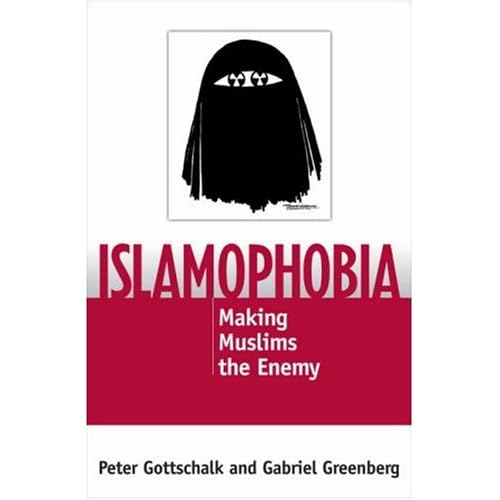
Also, an article called Cartoon Villains reviewed Islamophobia: Making Muslims the Enemy, by Professor of Religion Peter Gottschalk and Wes alumnus Gabriel Greenberg (see right).

While checking out these reviews for myself, I also came across the Times' Education Life section. I haven't read any of it yet, but it looks interesting and has features on campus protests, summer internships, and S.D.S..